Client Story · Hercules Candy
Every morning, someone printed the orders and checked the weather.
Hercules Candy has made candy by hand for 120 years, with techniques passed down through generations of one family. Their order review was almost as traditional: hundreds of orders a week — thousands in the busy months — each one checked by hand against the weather, the carriers, and the candy inside the box. We connected their systems and turned their judgment into rules, and left the final say exactly where it belongs.
The problem
The decisions lived in people's heads
Each order meant a tour: find it in Shopify, identify the candy and where it was headed, look up arrival-day temperatures on weather.com, compare FedEx and UPS for the fastest and cheapest service, work out cold packs from the candy type and transit time — then update ShipStation and print the label. Hundreds of times a week. Thousands in the busy months.
A tour for every order
Shopify to weather.com to the carrier sites to ShipStation — every order crossed four or five tools before a label printed, and none of them talked to each other.
Rules nobody wrote down
How many cold packs for boiled candy versus chocolate, in July, going to Texas? The answers lived in experienced heads — and the weather kept moving after every decision was made.
Refunds & upgrades by hand
A shipping upgrade meant manually calculating the cost difference, emailing the customer, and sending an invoice — all separate steps. Refunds worked the same way, one order at a time.
- Print the day's orders
- Check each one in Shopify — candy type, destination
- Look up arrival-day temperatures on weather.com
- Compare FedEx & UPS for the fastest, cheapest service
- Work out cold packs from candy type and transit time
- Update ShipStation and print the label
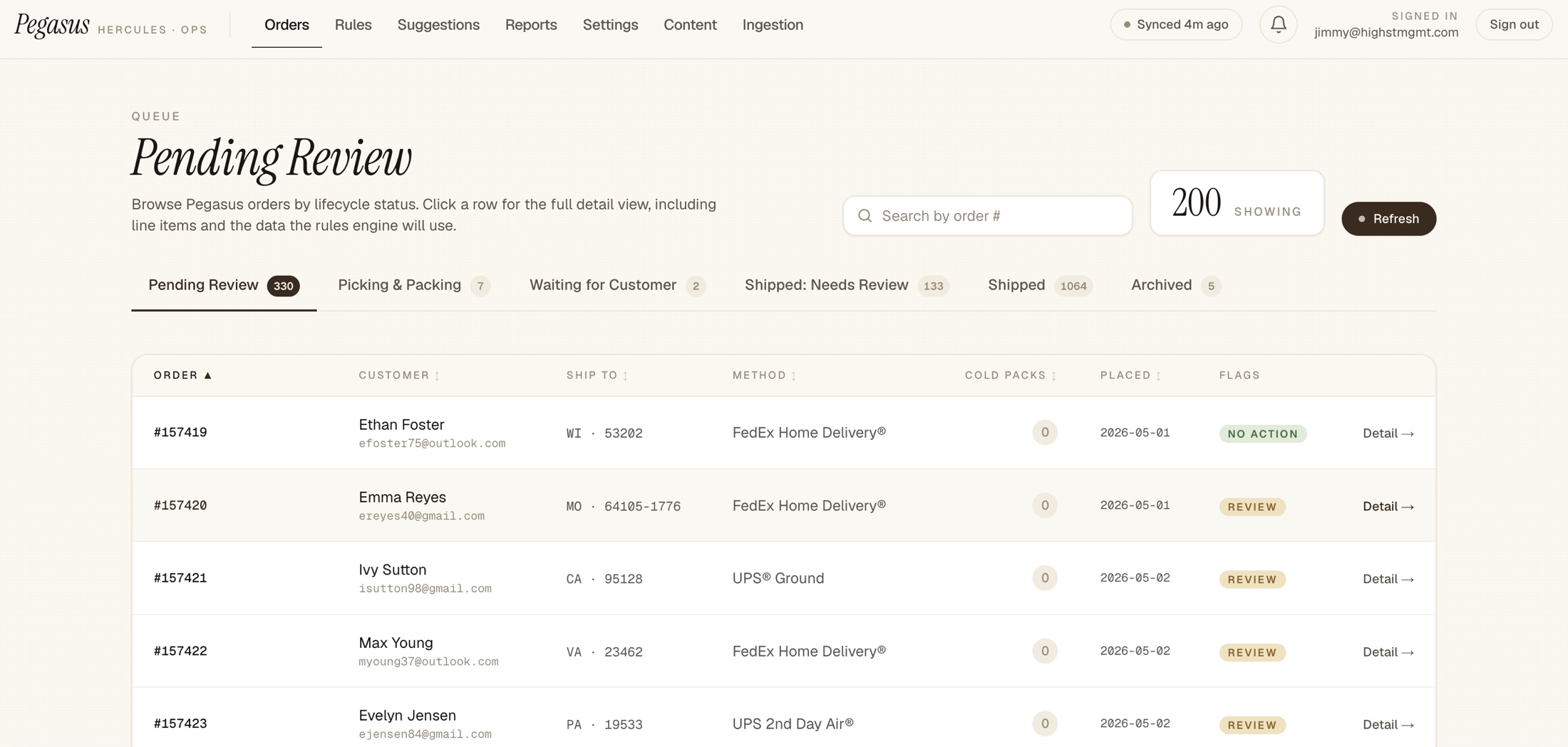
- Open the queue — every order already reviewed
- Scan the recommendations and the reasoning
- Change anything you disagree with
- Print — that's the approval
What we built
Their judgment, turned into a system
We connected the systems they already used — Shopify, ShipStation, the carriers, the weather — and encoded how they actually made decisions: a rules engine reviews every order against the forecast for its arrival date and live transit times, then queues its recommendation for a human to approve. Nothing was replaced. Everything was connected.
Every order, reviewed at 5am
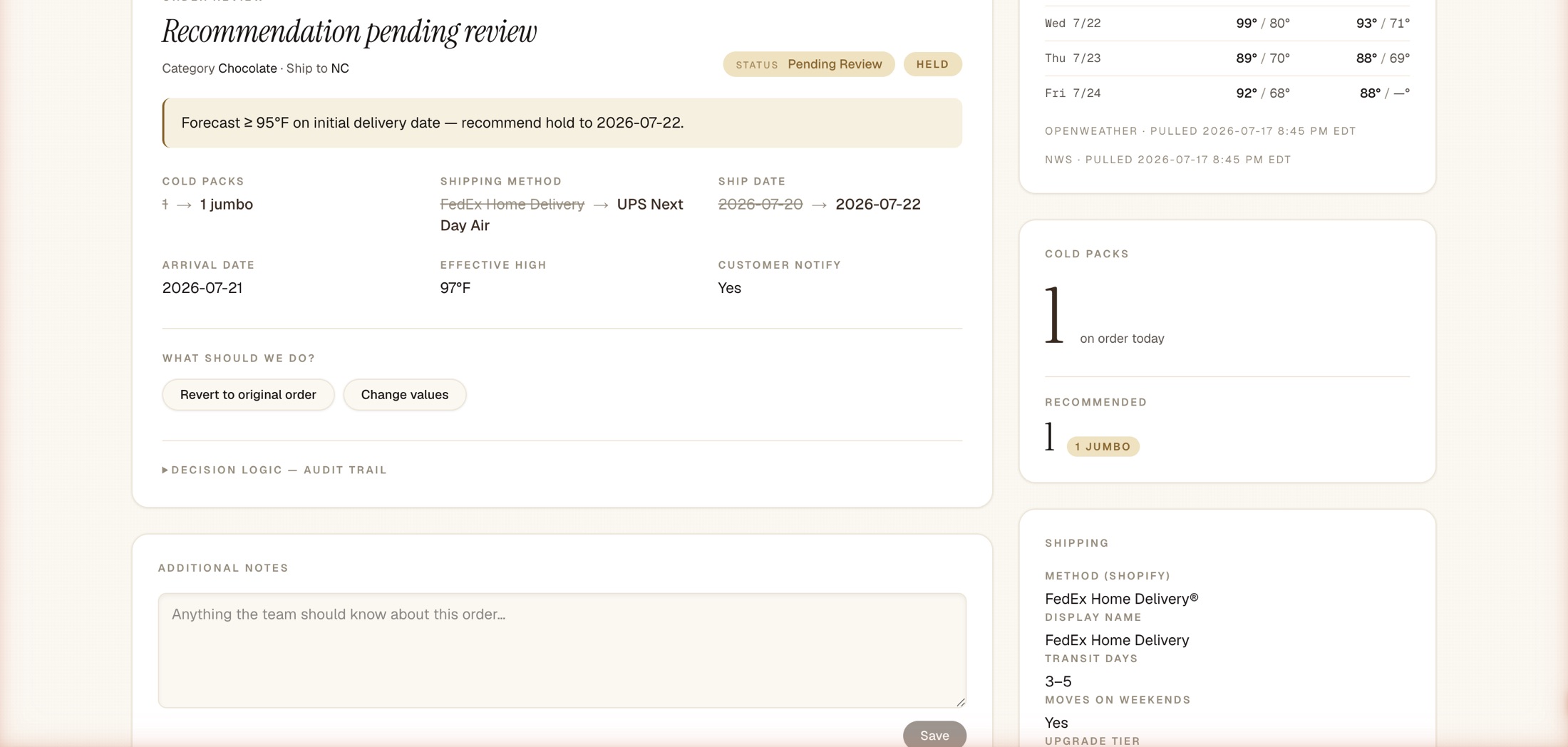
Cold-pack counts, shipping upgrades or cheaper swaps, heat holds, and flags — recommended automatically, with the full "why" attached to every call. Pending orders get re-checked as the forecast moves.
Approval built into the workflow
Staff open the morning queue, scan the recommendations, and print the pickslips — and printing is the approval. Disagree with a call? Change it from a dropdown. The team stays in charge; the busywork disappears.
Money moves only inside guardrails
Small, clear-cut cold-pack refunds are issued automatically at ship time — capped, audited, with anything ambiguous routed to a person. Hot orders trigger a pay-or-delay upgrade flow the customer confirms themselves.
Calculated, emailed, invoiced — in a click
The platform computes the shipping difference or refund automatically; staff review it and send the customer's email or invoice directly from the app, instead of juggling separate steps per order.
The client owns the logic
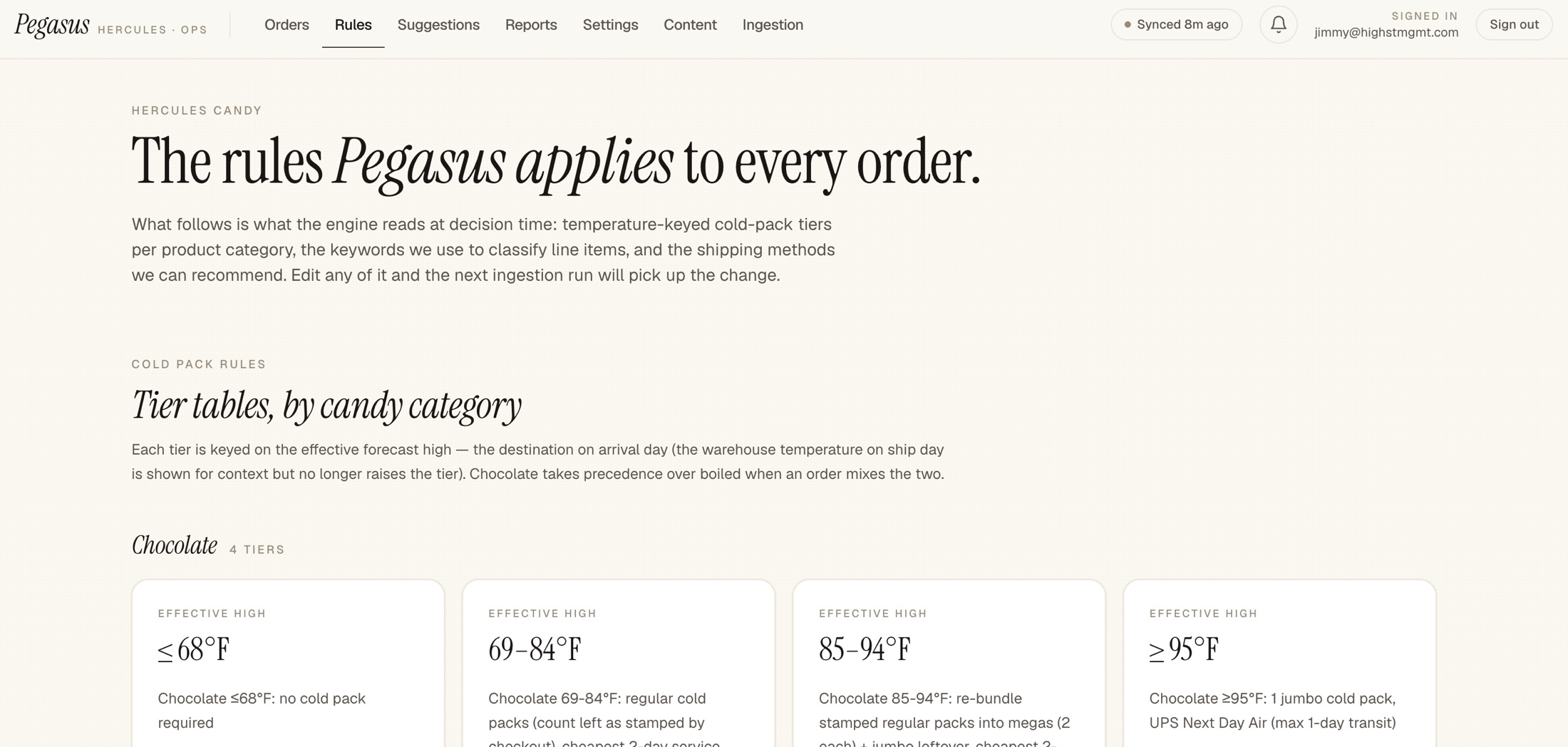
Every rule — cold-pack thresholds, product categories, shipping methods — is editable in settings, with an audit trail of every change and a plain-English page showing exactly what the engine will do.
The system learns from overrides
When staff consistently override a recommendation the same way, the platform notices and proposes a rule change — which a human reviews and applies. It never changes its own rules.
How it runs
A morning that used to take the morning
The platform runs the same rhythm the team always did — it just does the looking-up, cross-checking, and re-checking before anyone sits down. On the busiest days, a review that took several hours now takes less than one.
The batch runs
New orders are pulled from Shopify and reviewed against each one's arrival-date forecast and live carrier transit times. Every still-pending order is re-checked for forecast drift.
Staff work the queue
Each order shows the recommendation and the reasoning. Most get printed — which approves them, moves them to pick & pack, and pushes the confirmed shipping method to ShipStation.
The platform keeps watch
Fulfillments sync back every few minutes, bounded refunds go out at ship time, paid upgrade invoices release their orders automatically, and anything unusual raises a notification.
The scoreboard arrives
A weekly email reports every order reviewed, what the engine recommended, and what staff changed — a standing, honest measure of how well the system matches their judgment.
"Pegasus has streamlined our ordering process and eliminated so much manual labor. Our review process has gone from several hours to <1 on average."
Free 30-minute consult
What's the manual process running your mornings?
A free thirty-minute conversation about your business — no pitch, no pressure. You'll leave with at least one thing you can act on this week, whether or not we ever work together.
Schedule a Consult